
Why AI Agents Need Persistent Browser Identities
Randomizing browser fingerprints is easy. Keeping them consistent is hard.
AI agents rarely perform only one browser task. They authenticate, pause, return after a process restart, and sometimes run several unrelated workflows in parallel. Cookies and local storage matter, but they are only part of the browser identity that a site observes.
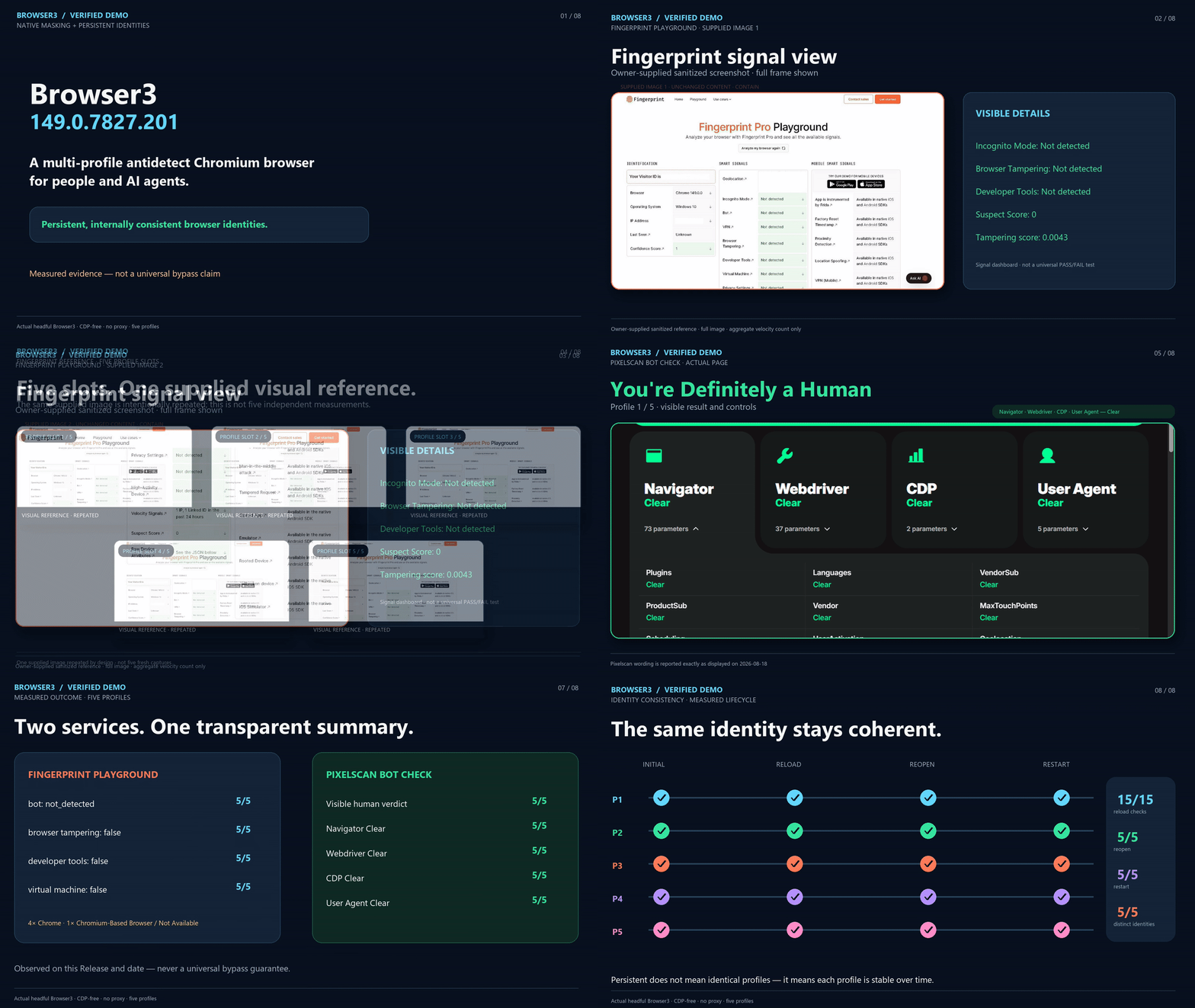
Sanitized TASK-005 v4 demo. The five-tile montage repeats one visual reference; it is not five new Fingerprint measurements. The dated scope and limitations are stated below.
A browser also exposes related signals such as User-Agent, User-Agent Client Hints, platform, screen characteristics, hardware buckets, locale, time zone, graphics data, and network context. Changing one value independently can create contradictions. Changing values again on every launch can make the same agent look like a different browser after a reload.
The useful engineering question is therefore not just:
Can a browser report a different fingerprint?
It is:
Can one saved browser identity remain coherent and reproducible across time?
Four separate properties
These ideas are easy to conflate:
- Masking changes selected browser-visible values.
- Consistency keeps related values coherent with one another.
- Persistence keeps the same profile identity and user state across later launches.
- Isolation prevents one profile from inheriting another profile's state.
Masking without consistency can produce a plausible-looking collection of contradictory values. Consistency without persistence still gives an agent a disposable session. Persistence without isolation risks mixing unrelated workflows.
Browser3 is a multi-profile antidetect Chromium browser for people and AI agents. Its primary differentiator is persistent, internally consistent browser identities. Native Chromium-level fingerprint masking is the implementation hook; consistency and persistence are what make each saved identity testable over time.
One agent, one saved profile
Each Browser3 profile combines a generated identity configuration with its own Chromium
user-data directory. The configuration has a persistent profile_id. Profile-specific
choices derive deterministically from that seed instead of fresh per-session randomness.
The user-data directory stores normal state such as cookies and web storage.
Selecting the same profile again reuses both:
.\browser3 --profile 1
Different profiles use separate user-data directories and profile locks. The intended mapping is simple:
one agent -> one persistent Browser3 profile
That mapping does not give an agent new permissions, solve authentication, or guarantee how a website will react. It creates a stable browser boundary that can be reproduced and debugged.
Masking lives inside Chromium
The Python layer probes the host, generates deterministic configuration, manages profiles, and launches the browser. It does not inject fingerprint JavaScript into pages. Browser-visible masking is implemented in the packaged native Chromium layer.
The public source boundary is deliberate: the repository exposes the MPL-2.0 orchestration, profile-generation policy, documentation, and release verification path. It does not expose the private native masking implementation or enough source to rebuild the distributed executable.
This distinction matters because a page-level JavaScript hook can change one readout without making related browser surfaces agree. Browser3 passes validated profile data to native browser code and preserves native behavior when a safe override is not available.
Normal launches are headful and CDP-free. Automation is opt-in through a loopback-only
CDP control path or the local Session API. In a five-profile Release measurement, an
active Playwright or Puppeteer client was visible to detector tooling as Developer
Tools in 5/5 profiles. That limitation is documented rather than treated as a
fingerprint-masking result.
Version details are part of consistency
The distributed Browser3 runtime is based on Chromium 149.0.7827.201. That does not
mean every browser surface reports the same four-part string.
The reduced User-Agent currently follows Chromium's reduced format and reports
149.0.0.0. High-entropy UA-CH and generated profile full-version values use
deterministic verified patches from 149.0.7827.196 through 149.0.7827.201.
Browser3 therefore does not claim exact .201 on every surface.
Hardware-bound capabilities, limits, color depth, and the ANGLE backend remain native. A GPU identity override is accepted only as one validated WebGL/WebGPU block; invalid data falls back to host behavior. Canvas and audio noise remain off by default because earlier testing detected them. The currently measured clean seeded diversity axes are text edging and font hiding.
What the five-profile validation found
The public lifecycle report is a dated observation for Browser3/Chromium
149.0.7827.201 on one physical Windows host and one network context. It used five
persistent profiles in a headful, CDP-free run without a proxy. It did not select one
favorable profile.
| Lifecycle check | Recorded result |
|---|---|
| Selected signals stable across reloads | 15/15 |
| Close and reopen | 5/5 |
| New browser-process restart | 5/5 |
| Distinct private profile signatures in each lifecycle phase | 5/5 |
The 15/15 reload total represents five profiles across three process cycles. Raw
identifiers and raw profile signatures are not published.
The immutable r3 release then passed its own headful, CDP-free, no-proxy gate on
2026-08-20. All five profiles returned scores and reload measurements. The recorded
five-profile averages were 0.0412 for the Fingerprint.com tampering model, 0.0654
for its virtual-machine model, and 0.1250 for the optional VPN model. These numbers
are observations of those models on that release and host, not targets or bypass
guarantees.
The deeper public cross-check dated 2026-08-15 also kept adverse results visible:
| Service | Recorded observation | What it does not prove |
|---|---|---|
| Fingerprint.com Playground | Tampering-model averages 0.0283-0.0335; VM-model averages 0.0580-0.0600 across three five-profile lifecycle phases |
No universal PASS; a visitorId is not proof of masking |
| Pixelscan | Navigator, webdriver, and CDP checks clear on 15/15; User-Agent check clear on 0/15 |
Mixed result, not an overall pass |
| OverpoweredJS | Automated collection errored on 15/15 |
No conclusion |
| CreepJS | A red warning appeared on 15/15 |
No overall pass |
| BrowserLeaks | Features Detection captured for 5/5; the reviewed viewport showed 322/322 features |
Surface availability, not a bypass verdict |
These services measure different things and can change independently of Browser3. A visitor identifier, a tampering signal, a bot verdict, and a lifecycle comparison are not interchangeable metrics. The complete method and limitations are in the public validation report.
A reproducible way to challenge the claim
Use the official Windows x64 r3 release and verify the detached OpenPGP signature and
SHA-256 manifest. Browser3-owned PE files are not Authenticode-signed. Keep the complete
runtime\ directory intact and use a physical hardware-accelerated GPU.
For a gate-compatible direct-network run, launch all five profiles without a proxy:
.\browser3 --profile 1 --no-proxy
.\browser3 --profile 2 --no-proxy
.\browser3 --profile 3 --no-proxy
.\browser3 --profile 4 --no-proxy
.\browser3 --profile 5 --no-proxy
For each profile:
- Load the same test with a fresh document between observations.
- Compare only selected stable signals.
- Close and reopen the same profile.
- Start a new browser process and repeat.
- Compare the result with the other four profiles.
- Record the release, date, host context, proxy mode, and whether CDP was active.
Do not publish cookies, IP or geolocation data, proxy credentials, visitor/request IDs, personal data, or raw profile signatures. The internal harness and raw baselines remain private; the public report exposes sanitized aggregates and enough protocol detail to challenge the conclusion without exposing sensitive test data.
Known limits
This is not a universal detector-evasion claim.
- The cited evidence covers one physical Windows host and one network context.
- The release gate ran without a proxy; proxy and multi-geo behavior were not part of that tested GO.
- Profiles are generated for the current machine and should not be moved to different hardware.
- The current runtime requires Windows x64 and a physical hardware-accelerated GPU.
- Widevine is not included; Windows N/KN may require the Media Feature Pack.
- The public source layer cannot rebuild the proprietary native executable.
- External detector models change over time, and the recorded results include mixed and unavailable outcomes.
Browser3 does not claim to be "undetectable" and does not guarantee an anti-bot bypass or a particular detector score.
Try it, then report a contradiction
Download the immutable
Browser3 v149.0.7827.201-r3 release
and follow the repository Quick Start. A Python 3.10+ client is
also published as browser3==0.1.0; the optional npm package
@radek-b3/browser3@0.1.0 is a thin wrapper around that Python client, not a separate
runtime.
The most useful experiments are simple:
- reopen the same profile after a full browser restart;
- compare its selected signals with another profile;
- test an automation lifecycle separately from a clean CDP-free run;
- report a reproducible inconsistency, limitation, or detector change.
Use Browser3 only on systems and accounts you own or are authorized to test. Please file sanitized, reproducible feedback through GitHub Issues or GitHub Discussions.
I maintain Browser3. This article is a request for technical criticism and reproduction, not an independent review or a promise of detector evasion.